
2.png)


Best Invisible & In-the-Ear Hearing Aids in 2026: A Local Guide from Clarity Hearing Care

Updated: Aug 11

Most of the time, when people talk about the “best hearing aids,” they are talking about receiver-in-canal hearing aids. Those are the small devices that sit behind the ear with a thin wire going down into the canal. We fit a lot of them at Clarity Hearing Care, and for many patients they are still the best overall choice.
But this article is not about those.
This article is for the person who says, “I really do not want anything behind my ear.” Maybe you wear glasses. Maybe you wear hats. Maybe you have tried hearing aids before and did not like the feeling of something sitting up top. Or maybe you simply want the smallest, cleanest, most discreet hearing aid option that still does the job.
If that sounds like you, this is your category.
We are talking only about in-the-ear hearing aids: IIC, CIC, ITC, ITE, custom hearing aids, and ready-to-wear in-canal devices. No behind-the-ear devices. No receiver-in-canal devices. This is the small and hidden side of hearing technology, and honestly, it is finally getting exciting again.
For years, the tiniest hearing aids were limited. They were discreet, but patients usually had to give up rechargeability, Bluetooth streaming, stronger directional microphone features, or enough power for more complicated hearing losses. In 2026, that old rule is starting to change. Not completely, because physics still matters. Ear canals are only so big. But this category has moved forward in a big way.
At Clarity Hearing Care, with offices in Osprey, Englewood and St. Petersburg, we fit these devices regularly. We fit a lot of Signia Silk, Starkey CIC and IIC, Starkey rechargeable custom, ReSound custom rechargeable, Phonak Virto rechargeable, Widex custom, and now Oticon Zeal has become one of the hottest new products in this entire space.
So let’s walk through what is actually out there, what we like, what we watch out for, and how we help patients decide what belongs in their ear.

First, What Counts as an In-the-Ear Hearing Aid?
When someone says they want an “invisible hearing aid,” they may be talking about several different styles. This is where it helps to slow down and use the right names, because every style has its own strengths and tradeoffs.
An IIC, or invisible-in-canal hearing aid, sits very deep in the ear canal. This is usually the most hidden custom style. In the right ear canal, it can be almost impossible to see from the outside. The tradeoff is space. There is very little room for batteries, wireless antennas, extra controls, or larger receivers.
A CIC, or completely-in-canal hearing aid, is also very discreet but usually sits slightly farther out than an IIC. CIC devices are often a sweet spot for patients who want a small custom hearing aid but may need a little more power, easier handling, or better retention.
An ITC, or in-the-canal hearing aid, fills more of the canal and lower bowl of the ear. It is more visible than a CIC, but it gives the manufacturer more room for features. This is where we usually start seeing stronger options for rechargeability, Bluetooth, controls, and power.
An ITE, or in-the-ear hearing aid, is the largest custom in-ear style. It may be a half-shell or full-shell design. It is more noticeable, but it can be a great choice for patients who want a custom fit, easier handling, strong battery life, and more technology in the shell.
Then we have newer ready-to-wear in-canal devices, like Signia Silk and Oticon Zeal. These are not traditional hard-shell custom hearing aids, but they can still sit very discreetly in the ear canal. For the right patient, they can be a great way to get a small in-canal fit without waiting for a custom shell to be manufactured.

The Real Tradeoff: Smaller Usually Means Fewer Features
This is the part we spend a lot of time explaining in the office. The smallest hearing aid is not automatically the best hearing aid. It may be the best-looking hearing aid. It may be the most hidden hearing aid. But once we go very deep and very small, we start running into real limitations.
A tiny IIC or CIC has less room for a rechargeable battery, less room for Bluetooth hardware, less room for multiple microphones, less room for a larger receiver, and less room for physical controls. That does not make it a bad choice. It just means we have to match the device to the person instead of matching the person to the brochure.
For some patients, a tiny deep-canal device is perfect. They want discretion, they have the right ear canal shape, their hearing loss fits the power range, and they do not care about streaming phone calls or music. For other patients, a slightly larger ITC or ITE may be better because it gives them more power, better battery life, rechargeability, Bluetooth, or easier handling.
That is the real work of fitting these products. The goal is not just to find the smallest device. The goal is to find the smallest device that still makes sense for your real life.
Oticon Zeal: The Discreet Device Everyone Is Talking About
Oticon Zeal is probably the hottest product in this category right now. The reason is simple: it gives patients a very discreet in-ear hearing aid without giving up the modern features people have been asking for.
Oticon lists Zeal as a discreet rechargeable in-the-ear hearing aid with Bluetooth LE Audio, hands-free calling, and Auracast broadcast audio support. That combination is a big deal because those features have traditionally been difficult to fit into small in-ear designs.
In the office, this is the kind of device that changes the conversation. For years, when someone asked for a tiny hearing aid, we had to explain that they could usually have small or Bluetooth, but not always both. Zeal makes that conversation much more interesting.
It is important to say this clearly: Zeal is not the same thing as a traditional custom-molded IIC. It uses a discreet in-ear design and a fitting approach that is different from a lab-made custom shell. That can be a major advantage for some patients because it can be quicker and more flexible. For other patients, a true custom shell may still be the better fit.
When someone comes into Clarity Hearing Care and says, “I want something small, rechargeable, and connected,” Oticon Zeal is absolutely one of the first devices we want to talk about.

Signia Silk Charge&Go IX: One of Our Favorite Ready-to-Wear In-Canal Options
Signia Silk has been one of the most practical in-canal options for a long time. The Signia Silk Charge&Go IX is especially important because it is small, rechargeable, ready-to-wear, and very discreet.
This is not a traditional custom shell. It uses soft sleeves to create the fit in the ear canal. That means we can often get a sense of comfort and cosmetics quickly, without waiting for a custom device to come back from the manufacturer. For the right ear, that is a huge advantage.
Signia describes Silk Charge&Go IX as a near-invisible, ready-to-wear rechargeable device that can be controlled through the Signia app, with a portable charger that provides charging on the go.
Here is the important detail: Silk Charge&Go IX does not directly stream Bluetooth audio. It is app-adjustable, but app control is not the same thing as streaming phone calls, music, podcasts, or TV sound directly into the hearing aids. That distinction matters because patients often use the word “Bluetooth” to mean different things.
In our clinics, Silk still earns its place because it solves a very real problem. A lot of people want something tiny, rechargeable, and discreet. They may not care about streaming. They may care more about comfort, simplicity, and cosmetics. For those patients, Silk can be a great fit.
If Signia releases a true Bluetooth-streaming Silk platform in the future, that could be a very big moment for this category. A rechargeable, nearly invisible, in-canal Signia Silk with true Bluetooth streaming would get a lot of attention.

Starkey Signature Series: One of the Best Custom IIC and CIC Families
If someone wants a true custom IIC or CIC, Starkey deserves a serious look. Starkey has always been strong in custom products, and the Signature Series is one of the best examples of what they do well.
The Signature Series includes tiny custom styles like IIC NW, CIC NW, and CIC R NW. StarkeyPro describes the Signature Series CIC R NW as the world’s smallest custom rechargeable hearing aid with up to 38 hours of battery life, and it also lists the IIC NW as the smallest-of-small option in the family.
This is where Starkey is really useful in the clinic. If the patient wants maximum invisibility, we may talk about the Signature IIC NW. If the patient wants a small custom rechargeable CIC and does not need Bluetooth streaming, we may talk about the Signature CIC R NW. If the patient wants a small wireless custom CIC, then we may talk about Starkey Omega AI CIC, knowing that this is a different product path and usually involves a disposable battery.
That is the key point with Starkey: you can chase invisibility, rechargeability, or wireless features, but in the tiniest CIC/IIC space you usually do not get every single thing in one device. The fitting is about choosing the best tradeoff.
We do a lot of Starkey CIC and IIC fittings because they have options that make sense for real patients. Some people just want the smallest custom device possible. Some want rechargeable. Some want a custom shell that feels secure. Starkey gives us a lot to work with.

Phonak Virto R Infinio: The Custom In-Ear Bluetooth Powerhouse
Phonak brings a different strength to the table. If a patient wants a custom in-ear hearing aid and Bluetooth is near the top of the list, Phonak Virto R Infinio is one of the most important options to consider.
Phonak lists Virto R Infinio as a custom rechargeable in-ear hearing aid with universal Bluetooth connectivity, including the ability to pair with up to eight Bluetooth devices and maintain two active connections.
That is a big deal for patients who use more than one device. Many people today have an iPhone or Android phone, a tablet, a computer, a TV connector, maybe even a work phone. Phonak’s Bluetooth flexibility can make daily life easier for the right person.
The tradeoff is size. Virto R Infinio is not a tiny IIC. It is a custom rechargeable in-ear device, and in most cases it will be more visible than the deepest invisible-style hearing aids. But if the patient wants custom fit, rechargeable convenience, and strong Bluetooth, Phonak is hard to ignore.
This is a great example of why we do not choose by brand first. We choose by priority. If the top priority is the smallest possible device, we may look elsewhere. If the top priority is a custom in-ear hearing aid with strong streaming and phone connection, Phonak moves way up the list.
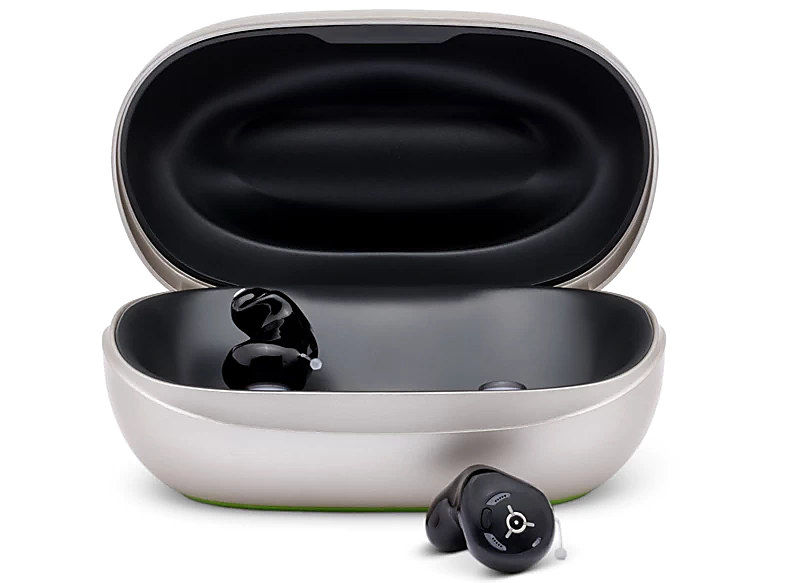
ReSound Nexia Custom: Strong ITC and ITE Rechargeable Options
ReSound is a strong option when someone wants a custom in-ear hearing aid with a modern feature set, especially in the ITC and ITE sizes.
The ReSound Nexia custom rechargeable ITC and ITE options are important because they bring ReSound’s newer platform into custom shells. ReSound has also been very forward-looking with Bluetooth LE Audio and Auracast, which is expected to play a bigger role in public audio spaces over time.
In plain English, Auracast is the future of shared audio. Think airports, churches, theaters, museums, lecture halls, gyms, and other places where audio could eventually be broadcast directly to compatible hearing devices.
ReSound also offers CIC options, but the smallest CIC-style solutions are usually more traditional. They can be discreet and custom, but they do not carry the same rechargeable Bluetooth feature set as the larger custom ITC and ITE models.
So when we are fitting ReSound custom, the question is usually this: does the patient want the smallest possible custom CIC, or do they want a custom rechargeable in-ear device with stronger technology? If the answer is rechargeability and future-facing connectivity, we usually look more toward the ITC or ITE custom styles.
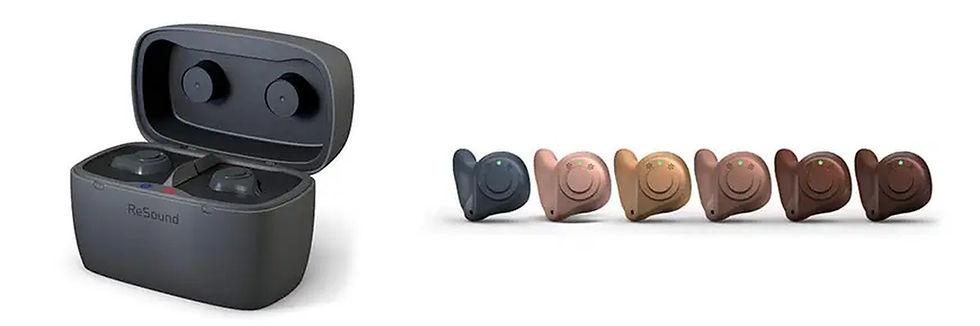
Widex Allure ITE R D: Custom Rechargeable With a Natural Sound Focus
Widex has a very loyal following. A lot of people who wear Widex love the sound quality. It has a reputation for sounding natural, especially for patients who are sensitive to hearing aids that feel sharp, mechanical, or overly processed.
The Widex Allure ITE R D is the important in-ear product to know here. Widex lists Allure ITE R D as a custom rechargeable in-the-ear hearing aid with hands-free Bluetooth, app control, contactless charging, and up to 19 hours of use from a four-hour charge when including five hours of streaming
This is not a tiny invisible CIC. That is the honest tradeoff. But for someone who wants a custom rechargeable in-ear hearing aid, Bluetooth, and Widex’s natural sound approach, Allure ITE R D is a very serious option.
In the office, Widex is often a good conversation for the patient who says, “I want this to sound smooth. I do not want everything to sound tinny or harsh.” Every ear is different, but Widex has a sound quality story that many patients appreciate.

What We Have Found to Be True in the Clinic
Patients do not walk into our office asking for “Bluetooth LE Audio,” “Binaural OneMic Directionality,” or “Auracast-ready custom ITC platforms.” Those words may matter to us as providers, but patients usually ask much more practical questions.
They ask if people will see the hearing aid. They ask if it will be comfortable. They ask if they can handle it. They ask if it will help in restaurants. They ask if it will work with their phone. They ask if they have to change batteries. They ask if they are going to feel plugged up.
Those are the right questions.
In real life, the best in-the-ear hearing aid is not always the newest or the smallest. It is the one that fits the ear, matches the hearing loss, and makes the patient’s daily routine easier instead of harder.
We have seen patients do beautifully with Signia Silk because they wanted something small and simple. We have seen patients love Starkey IIC because it is nearly invisible and custom-made. We have seen patients choose Phonak Virto because Bluetooth mattered more than maximum invisibility. We have seen patients get excited about Oticon Zeal because it feels like the first time a truly discreet device did not require as many sacrifices.
We have also seen patients come in convinced they wanted the tiniest device possible, only to realize a slightly larger ITC gave them better sound, better handling, and a better overall experience. That is why the consultation matters.
Bluetooth vs. App Control: Please Know the Difference
This is one of the most important parts of the entire article. When people say “Bluetooth,” they often mean different things. Some people mean they want to adjust the volume from their phone. Some mean they want phone calls, music, podcasts, or TV streamed directly into the hearing aids.
Those are not all the same.
A hearing aid can be app-adjustable without directly streaming audio. That is the case with Signia Silk Charge&Go IX. It can be controlled through the app, but it does not directly stream Bluetooth audio.
Other devices, like Oticon Zeal and Phonak Virto R Infinio, are much stronger direct streaming conversations. So if Bluetooth matters to you, we will ask a follow-up question: “What do you want Bluetooth to do?” That answer helps us avoid choosing the wrong device.
Who Is a Good Candidate for Invisible or In-the-Ear Hearing Aids?
A good candidate is usually someone who wants a discreet device, has an ear canal that can comfortably hold it, has a hearing loss that fits the power range, and understands the tradeoffs. These devices can be great for people who wear glasses, hats, masks, oxygen tubing, or simply dislike the feeling of something behind the ear.
A person may not be the best candidate if they need a lot of power, have heavy wax or moisture problems, have very narrow canals, need the strongest possible speech-in-noise performance, or have dexterity concerns that make tiny devices frustrating.
That does not mean we rule anything out too early. It just means we test, look, fit, verify, and talk honestly.
How We Fit These Devices at Clarity Hearing Care
When someone comes into Clarity Hearing Care asking about invisible or custom in-ear hearing aids, we do not start by picking a brand. We start by understanding the person.
We talk about where hearing is hardest, what the patient has tried before, what they liked, what they hated, whether they care more about invisibility or features, whether they want rechargeable, whether Bluetooth matters, and how comfortable they are handling tiny devices.
Then we look in the ears. This part is not just a formality. Ear canal shape, wax, moisture, sensitivity and available space can completely change the recommendation.
After that, we test the hearing and talk through realistic options. Sometimes we can try a ready-to-wear in-canal device like Signia Silk or Oticon Zeal quickly. Sometimes a true custom device makes more sense, and we take impressions or order the correct style based on the manufacturer’s requirements.
When the devices arrive, the fitting is not just “put them in and send you home.” We program them, verify they are doing what they are supposed to do, teach you how to insert and remove them, show you how to clean them, and then adjust based on real-world use.
The first fitting is the beginning, not the finish line. Most hearing aids need fine-tuning after the patient wears them in restaurants, cars, church, family gatherings, work, and everyday life. That follow-up is where local care matters.

So, Which One Is Best?
There is no single best invisible hearing aid for everyone, but there are clear standouts depending on the goal.
If you want one of the most exciting discreet connected options, Oticon Zeal is probably the biggest headline right now.
If you want a ready-to-wear rechargeable in-canal device and direct streaming is not your main priority, Signia Silk Charge&Go IX is one of the strongest options.
If you want custom in-ear Bluetooth, Phonak Virto R Infinio is one of the best conversations.
If you want maximum custom invisibility, Starkey Signature IIC deserves serious attention.
If you want a tiny rechargeable custom CIC and do not need wireless streaming, Starkey Signature CIC R NW is a standout.
If you want a custom rechargeable ITC or ITE with future-facing connectivity, ReSound Nexia custom rechargeable is a strong option.
If you want custom rechargeable with a natural sound focus, Widex Allure ITE R D is worth discussing.
The best one is not the one with the longest feature list. The best one is the one you will actually wear, manage, and benefit from every day.

The Bottom Line
Invisible and in-the-ear hearing aids are finally having their moment.
For a long time, the small devices were mainly about cosmetics. Now they are becoming more practical, more rechargeable, more connected, and more capable than they used to be.
But the right choice still comes down to the ear in front of us.
At Clarity Hearing Care, we want patients to feel comfortable asking for what they really want. If you want something invisible, tell us. If you want Bluetooth, tell us. If you do not want anything behind your ear, tell us. If you are worried about handling something tiny, tell us that too.
Our job is to help you understand what is possible, what is realistic, and what will actually work in your day-to-day life.
Whether you are in Osprey, Nokomis, Venice, Sarasota, Englewood, Wellen Park, North Port, Port Charlotte, St. Petersburg or Pinellas County, we would be happy to help you compare the newest invisible, CIC, IIC, ITC and custom in-the-ear hearing aids.
Frequently Asked Questions About Invisible and In-the-Ear Hearing Aids
Are invisible hearing aids rechargeable now?
Some are. Rechargeability is moving into smaller in-the-ear styles, but not every IIC or CIC is rechargeable. Oticon Zeal, Signia Silk Charge&Go IX, Signia Insio Charge&Go CIC IX, Starkey Signature CIC R NW, Phonak Virto R Infinio, ReSound Nexia custom rechargeable, and Widex Allure ITE R D are all part of this newer rechargeable in-ear conversation.
Can invisible hearing aids stream Bluetooth?
Some can, but many tiny in-canal devices still cannot. Oticon Zeal supports Bluetooth LE Audio. Phonak Virto R Infinio is a strong custom Bluetooth option. Signia Silk Charge&Go IX is app-adjustable but does not directly stream Bluetooth audio.
What is the difference between IIC and CIC?
An IIC sits deeper in the ear canal and is usually the most invisible. A CIC is also very discreet but usually sits slightly farther out, which may allow a little more flexibility for power, handling or fit.
Which hearing aid is best if I want the smallest possible device?
For maximum invisibility, we usually look closely at IIC and CIC options such as Starkey Signature IIC, Starkey Signature CIC, Oticon Own SI IIC, Phonak Virto I-Titanium, and similar deep-canal devices. The best choice depends on your ear canal and hearing loss.
Which hearing aid is best if I want Bluetooth?
For Bluetooth in this category, Oticon Zeal and Phonak Virto R Infinio are two of the strongest conversations. Larger ITC and ITE custom devices generally offer more complete wireless features than tiny IIC or CIC styles.
Ready to Find Out What Fits Your Ear?
If you are curious about invisible, CIC, IIC, ITC or custom in-the-ear hearing aids, schedule a free hearing exam with Clarity Hearing Care.
We will help you compare the newest options, explain what is realistic, and show you what these devices actually look and feel like.
Call the office closest to you:
Clarity Hearing Care
2101 S. Tamiami Trl.
Osprey, FL 34229
(941) 477-2101
Clarity Hearing Care
2828 S. McCall Rd
Englewood, FL 34224
(941) 475-9909
Clarity Hearing Care
6701 38th Ave N Ste. A
St. Petersburg, FL 33710
(727) 624-6701
Or visit clarityhearingcare.com to request an appointment.
Directions To Our Locations

