
2.png)



Your Medicare Advantage Hearing Benefit Should Not Mean Settling for Less

Updated: 5 days ago
MEDICARE ADVANTAGE HEARING HELP NEAR VENICE, OSPREY, ENGLEWOOD AND SOUTH SARASOTA
If the card in your wallet says Aetna, UnitedHealthcare, Humana, Florida Blue, Blue Cross Blue Shield, Anthem or Cigna, you may have a hearing benefit that can help with testing, prescription hearing aids or related services. But the company name on the card is only the beginning. Your exact plan, hearing-benefit network, product choices, copay and local provider participation all matter.
That is why Clarity Hearing Care has made a deliberate commitment: continue working with most major Medicare Advantage and hearing-benefit networks used by people in our Gulf Coast communities, while delivering the same careful testing, current technology, experienced fitting and long-term support we would want for our own families.
From our offices in Osprey and Englewood, we help people from Venice, Nokomis, Laurel, Palmer Ranch, Beneva, Gulf Gate, Vamo, South Sarasota, Wellen Park, Rotonda West, Placida, Cape Haze, North Port and nearby communities. Our St. Petersburg office provides the same insurance-verification starting point for patients in Pinellas County.
✅ The quick answer
Original Medicare generally does not cover hearing aids or hearing-aid fitting exams. Many Medicare Advantage plans add hearing benefits, but coverage is plan-specific. In 2026, KFF reports that 98% of individual Medicare Advantage plans offer some type of hearing benefit; that category may include exams, hearing aids or both, and the details vary. Clarity can check your actual benefit before you make a decision.
A Hearing Benefit Is Valuable. Understanding It Is Better.
━━━━
The most common misunderstanding is believing that the health-insurance company printed on the card always manages the hearing-aid benefit directly. Often, a health plan contracts with a separate hearing-benefit administrator. Names such as NationsHearing, TruHearing, UnitedHealthcare Hearing, EPIC Hearing Healthcare, Hearing Care Solutions and Amplifon may appear in the process.
In plain language, the path may look like this: your Medicare Advantage plan determines the benefit; a hearing network administers it; an enrolled local provider tests and fits you; and the plan or network sets the approved products, copays, service terms and authorization steps. Two people carrying similar-looking cards can have different hearing benefits because they selected different plan contracts.
🔎 What to verify before choosing a provider
Is the clinic currently in network for your exact plan?
Which products and technology levels are included?
What is your expected out-of-pocket cost?
Is authorization or a referral required?
How many follow-up visits are included, and how are repairs handled?
What happens if you move or spend part of the year elsewhere?
Provider directories are a starting point, not the final word. Medicare’s own network guidance explains that Medicare Advantage provider networks can change and that patients should confirm participation when scheduling. The contracted location you are offered may be a full-time clinic, a satellite office, a mobile service or another care model. None of those labels alone tells you whether the fit is right. Compare accessibility, experience, technology choice, fitting standards and who will be available for follow-up.

Plans and Hearing Networks We Commonly Verify
━━━━
Aetna and UnitedHealthcare are among the cards our team sees most often, but Clarity’s insurance work is broader than two companies. Depending on the specific plan and service area, we commonly check benefits connected with:
Aetna Medicare Advantage, including plans whose hearing benefit is administered through NationsHearing.
UnitedHealthcare and AARP Medicare Advantage, including UnitedHealthcare Hearing or EPIC-related benefits when applicable.
Humana Medicare Advantage hearing benefits.
Florida Blue Medicare, Blue Cross Blue Shield and Anthem plans, with benefits and administrator varying by contract.
Cigna and plan-specific hearing benefits.
NationsHearing, TruHearing, Hearing Care Solutions and Amplifon programs.
Federal Employee Program and other eligible employer or retiree hearing benefits.
This list describes plans and networks Clarity commonly verifies; it is not a guarantee of coverage. Benefits, provider status, service areas, product lists and authorizations can change. Your plan’s current eligibility response and written benefit terms control.
Why Clarity Continues to Accept Major Hearing Benefits
━━━━
Hearing-care networks are changing. Some practices participate in only a few plans, some leave networks, and others limit the days or locations where benefit appointments are available. Consolidation is also changing who owns hearing clinics and how care is delivered. Those are business realities, but they are not the patient’s problem to solve.
Clarity’s position is simple: access to a benefit should not require accepting a lower standard of care. We view broad insurance participation as a service to the community, especially for older adults who chose a Medicare Advantage plan partly because it advertised hearing coverage. Our current intention is to keep serving these patients for years to come, subject—as always—to plan contracts and network requirements.
Brad Wagner and Kevin Wagner are Board Certified Hearing Aid Specialists with more than 45 years of combined experience. Clarity works with six leading prescription manufacturers—Oticon, Phonak, Signia, Starkey, Widex and ReSound—and maintains current training, fitting equipment and local follow-up care. Using insurance does not make you a second-class patient.
At the same time, a network benefit is not automatically the best value for every person. The contracted product list may be narrower, the copay may be close to a direct-pay option, or the included service package may not match your priorities. We will explain the benefit, then compare it honestly with transparent private-pay choices. If appropriate, ask whether the Clarity Access Program or another direct-pay pathway offers more flexibility for your preferred brand, technology or service plan. Eligibility, pricing and included care should always be reviewed for your specific situation.
📲 Verify Your Hearing Benefit Online Before You Visit
━━━━
Clarity’s secure Online Insurance Verification tool makes the first step easier. Instead of spending an afternoon moving between a plan call center, a hearing network and several offices, you can upload the front and back of your insurance card with the requested identification. Our team uses that information to check the items that actually affect your decision.
Whether Clarity is currently in network for your exact plan.
Whether the benefit includes a hearing evaluation, hearing aids or both.
Your allowance, copay or expected out-of-pocket amount when available.
Which technology levels, brands or models the network makes available.
Any authorization, referral, frequency limit or service requirement.
Verification is not a promise of payment; the plan makes the final coverage determination. It is, however, a much better foundation than guessing from a logo or choosing a provider before you understand the benefit.


👂 When Is It Time to Have Your Hearing Checked?
━━━━
Hearing loss often arrives gradually, which is why the person experiencing it may be the last to recognize the pattern. The National Institute on Deafness and Other Communication Disorders reports that about 15% of American adults say they have some trouble hearing. Roughly one in three adults ages 65 to 74 has hearing loss, and nearly half of adults older than 75 have difficulty hearing.
A free hearing evaluation is sensible when you notice any of these changes:
Group conversations are harder to follow than one-on-one conversations.
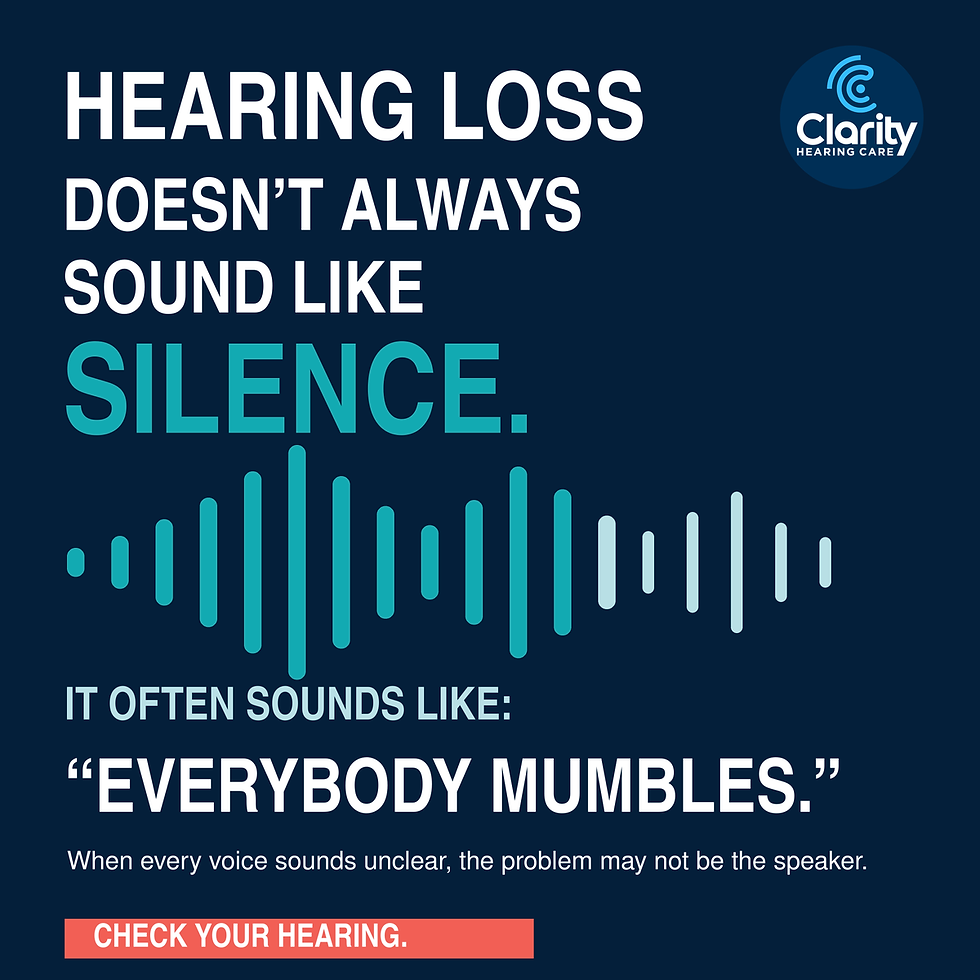
You ask people to repeat themselves or feel that everyone is mumbling.
The television, radio or phone keeps getting louder.
You understand better when you can see the speaker’s face.
Restaurants, clubhouses, worship services or family gatherings feel exhausting.
Tinnitus—ringing, buzzing or another sound without an outside source—has become noticeable.

🧠 “Use It or Lose It”—What That Really Means
━━━━
Brad often explains hearing in plain language: “Use it or lose it.” That does not mean a hearing aid is a proven way to prevent dementia, and it does not mean everyone with untreated hearing loss will experience the same outcome. It means the brain needs a clear, consistent signal to do the best possible job of recognizing speech, locating sound and separating voices from background noise.
Long-standing hearing difficulty can add listening fatigue, misunderstandings, withdrawal from conversations and safety problems. Hearing loss is also associated with social isolation, depression and cognitive decline. Association is not the same as proof of cause, but there is no advantage in waiting years to establish a baseline and learn what is happening.
The large ACHIEVE randomized trial did not show that hearing treatment slowed cognitive decline for every participant. A later analysis found meaningful benefit in participants at higher predicted risk for cognitive decline, including a 48% reduction in a higher-risk study group over three years. The responsible conclusion is not “hearing aids prevent dementia.” It is that good hearing care supports communication and daily life now, and may be especially important for some higher-risk older adults.
Modern Hearing Aids Are Easier to Live In
━━━━
Years ago, many fittings relied on tighter custom earmolds to control feedback. Some patients fought whistling, pressure, moisture, irritation or a plugged-up sensation, and getting eight hours of daily wear could be a struggle. Those experiences still shape what people expect from hearing aids—even though the technology and fitting options have changed dramatically.
Today’s prescription hearing aids can use open-fit receiver-in-canal designs, smaller custom shells, sophisticated feedback management, rechargeable batteries, automatic environment classification, directional microphones, smartphone streaming and remote adjustments. The correct choice still depends on the hearing loss, ear anatomy and lifestyle, but modern options are more wearable than many people remember.
💬 Brad’s practical advice

Once the hearing aids are comfortable and tuned for your hearing and lifestyle, wear them during most waking hours. Put them in in the morning and let your brain work with a consistent signal. In our clinics, it is no longer unusual for a comfortable, successful wearer to reach 14 to 16 hours on many days. That is a practice observation, not a promise for every patient.
ASHA similarly advises new users to wear hearing aids daily during most waking hours so the brain can adapt to sounds that have been missing. A 2026 report from the ACHIEVE intervention found average use of 9.3 hours per day among participants who completed the hearing intervention. Comfort and consistency matter more than forcing an arbitrary number. Pain, swelling or persistent whistling is a reason to call for an adjustment—not a reason to abandon hearing care.
🔔 What About Tinnitus Treatment and Insurance?
━━━━
Tinnitus affects an estimated 10% to 25% of adults, and most people with tinnitus also have some degree of hearing loss. There is no single cure that works for every person. When tinnitus occurs with hearing loss, properly fitted hearing aids are one of the main management options because they improve access to outside sound and may make the internal sound less dominant. Sound therapy, education, sleep support and behavioral approaches may also help.
Insurance coverage for tinnitus support depends on the plan, diagnosis and service. A hearing benefit may help with hearing aids when hearing loss is present, but it should not be described as insurance “covering a tinnitus cure.” Clarity can evaluate your hearing, discuss appropriate options and recommend medical or ENT referral when symptoms call for it. Sudden hearing change, tinnitus in one ear, pulsing with the heartbeat, severe dizziness or other neurological symptoms deserve prompt medical attention.
📍 Local Medicare Advantage Hearing Help Across the Gulf Coast
━━━━
Osprey, Venice, Palmer Ranch, Beneva and South Sarasota
The Osprey office is positioned between Sarasota and Venice for people who want a nearby independent hearing center without driving into a hospital system or relying on a rotating location. Patients come from Osprey, The Oaks, Sorrento Shores, Bay Acres, Pine Run, Rivendell and the Blackburn Point corridor, as well as Nokomis, Laurel, Casey Key, Venice and South Venice.
To the north, Clarity also serves Palmer Ranch and Beneva South along Central Sarasota Parkway, including Prestancia, Stoneybrook, Turtle Rock, VillageWalk, The Isles, Deer Creek and Silver Oak. From Gulf Gate, Gulf Gate Woods, Gulf Gate East, Vamo, Pelican Cove, Coral Cove, Mobile Estates, Stickney Point, South Sarasota and the southern Clark Road corridor, the Osprey team is a practical option for insurance verification, free testing, hearing aid repair, clean-and-check visits, Bluetooth help, programming and second opinions—even for many devices purchased elsewhere.
📍 2101 S. Tamiami Trail
. Osprey, FL 34229
🕒 Monday–Friday, 9:00 a.m.–4:00 p.m.
Englewood, Wellen Park, Rotonda West and the Cape Haze Peninsula
The Englewood office helps patients from Englewood, Wellen Park, Rotonda West, Grove City, Placida, Cape Haze, Manasota Key, Gulf Cove, South Gulf Cove, North Port and Port Charlotte. Seasonal residents appreciate being able to verify benefits before arriving and having a local team for cleaning, troubleshooting, humidity-related maintenance, programming and follow-up.
📍 2828 S. McCall Road, Suite 43
Englewood, FL 34224
🕒 Monday–Friday, 10:00 a.m.–4:00 p.m.
St. Petersburg and Pinellas County
In Pinellas County, the St. Petersburg office serves St. Pete, Tyrone, Jungle Terrace, Disston Heights, Kenneth City, Pinellas Park, Gulfport, South Pasadena, Seminole and Madeira Beach. Patients can start with the same online benefit-verification process and local free hearing evaluation.
📍 6701 38th Avenue N., Suite A
St. Petersburg, FL 33710
❓ Frequently Asked Questions About Medicare Advantage Hearing Benefits
━━━━
Does Original Medicare cover hearing aids?
Original Medicare generally does not cover hearing aids or exams for fitting hearing aids. Medicare Advantage plans may offer additional hearing benefits, and coverage varies by plan.
Which Medicare Advantage plans does Clarity accept?
Clarity works with most major plans and hearing networks common in our communities, including benefits connected with Aetna, UnitedHealthcare, Humana, Florida Blue, Blue Cross Blue Shield, Anthem, Cigna, NationsHearing, TruHearing, Hearing Care Solutions, Amplifon and others. Current participation must be verified for your exact plan.
Does Aetna use NationsHearing?
Some Aetna Medicare Advantage plans use NationsHearing to administer hearing benefits, but not every Aetna product is identical. Clarity can check the member ID and plan details before the appointment.
Does UnitedHealthcare or an AARP Medicare Advantage plan include hearing aids?
Many UnitedHealthcare and AARP Medicare Advantage plans include hearing benefits through UnitedHealthcare Hearing or a related network. Product choices, copays, replacement frequency and provider rules depend on the specific plan.
Do I have to use the first provider listed on the back of my card?
You generally must follow your plan’s network rules to use an in-network benefit, but you may have more than one participating provider available. Ask the plan or Clarity to confirm whether the location you prefer is currently eligible under your exact benefit.
Can I compare my insurance benefit with private-pay hearing aids?
Yes. A benefit can be valuable, but the lowest net cost or best overall fit may sometimes be a transparent direct-pay option. Clarity can compare product choice, service, warranty and out-of-pocket cost, including the Clarity Access Program when appropriate.
Does hearing insurance cover tinnitus treatment?
Coverage varies. If tinnitus occurs with hearing loss, a hearing-aid benefit may apply to eligible devices that can also support tinnitus management. No plan should be described as paying for a guaranteed tinnitus cure.
How do I verify my benefit with Clarity?
Use Clarity’s secure online insurance form to upload the requested card images and identification, or call the nearest office. The team will review current network and benefit information, then explain the options in plain language.
Use the Benefit You Chose—With a Team You Choose
━━━━
You should not have to choose between using a Medicare Advantage hearing benefit and receiving experienced, current, local hearing care. Clarity brings the two together: broad plan participation, straightforward verification, six prescription brands, free hearing testing, careful fitting, repairs, programming, tinnitus support and follow-up from people who will still be here when you need help.
Insurance benefits, provider participation, product availability and network rules vary by plan and may change. Verification is not a guarantee of payment. Hearing aids do not cure hearing loss, tinnitus or dementia. Seek prompt medical care for sudden hearing loss, one-sided or pulsatile tinnitus, severe dizziness, ear drainage, significant pain or other urgent symptoms.

Brad Wagner, HAS, BC-HIS
Co-Owner, Clarity Hearing Care


Comments