
2.png)


Best Hearing Aid of 2026? Oticon Reveal vs. Phonak EON Sphere vs. Signia MaX vs. ReSound Sensia

Updated: 3 days ago
Updated August 24, 2026 | About a 10-minute read
Four new premium hearing aids arrived within two weeks, creating one of the biggest hearing-aid launch windows in recent memory.
ReSound Sensia was publicly unveiled on August 10. Oticon Reveal followed on August 11. Then Phonak EON and Signia MaX both launched on August 24.
The timing is not proof that anyone coordinated a calendar. It does feel like four manufacturers walking into the same noisy restaurant, setting their newest AI systems on the table and asking:
Which is the most advanced hearing aid for understanding speech in noise in 2026?
The honest answer is not one logo. It depends on what your version of “background noise” actually is:
“The whole room becomes one roar.” Phonak Audéo EON Sphere E90 makes the strongest launch case for aggressive speech separation in severe, diffuse noise.
“I lose the group when everybody trades turns.” Signia Pure Charge&Go MaX 7 is built around coordinating several moving conversation partners.
“A louder side voice steals my attention.” ReSound Sensia 9 microRIE is designed to favor the person the wearer is facing.
“Speech is clearer, but the room feels shut down.” Oticon Reveal 1 tries to improve speech while preserving useful environmental context.
We hear all four complaints in the office. Patients use the same phrase—“I struggle in noise”—while describing completely different listening failures.

Four New Premium Hearing Aids Arrived Within Two Weeks
Platform | Media preview or prelaunch | Public launch | First-market availability |
ReSound Sensia | August 4–5 media event | August 10, 2026 | August 20 in the U.S., Germany and Austria |
Oticon Reveal | No public media-preview date found | August 11, 2026 | Initial August availability; wider Q3 rollout |
Phonak EON | July media preview | August 24, 2026 | U.S. August 24; additional markets in September |
Signia MaX | June 15–17 media event | August 24, 2026 | U.S., Germany and Nordic markets August 24 |
Oticon and Phonak often answer one another near the top of the market. This time, Signia entered with its largest system-level change in years, while ReSound arrived first with a different idea: the hearing aid should not simply chase the loudest voice—it should infer
whom the wearer intends to hear.
What Is Actually New Under the Hood?
All four products use AI, but they do not give it the same job. One separates speech, one coordinates the whole moment, one keeps an intended person ahead, and one balances speech with the rest of the scene.
Oticon Reveal 1: The Balancer
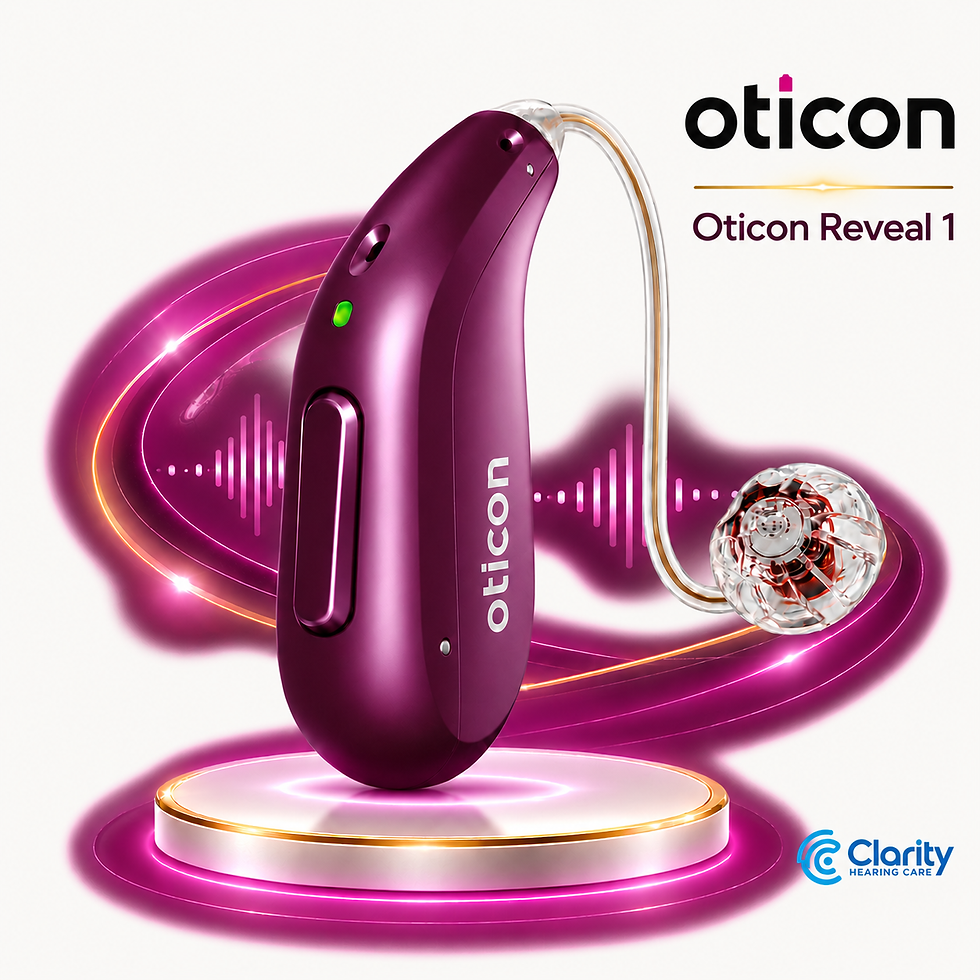
Reveal uses two integrated, always-on AI systems. Speech AI identifies and prioritizes voices while Context AI analyzes useful surrounding sound. At dinner, that can mean keeping your spouse clear without erasing the server, dishes and room cues that help the scene feel natural.
Reveal is more than a renamed Intent. It adds the new Reveal AI platform, updated wireless hardware, revised feedback prevention and 4D user-intent sensing. Oticon publishes up to 12 dB of AI Noise Suppression in difficult environments and up to 40 dB of wind and handling-noise attenuation.
Bottom line: new platform, familiar Oticon philosophy. Oticon confirms two AI systems—not two publicly confirmed DNNs.
Phonak Audéo EON Sphere E90: The Extractor

The new HYPERSONIC AI chip runs a retrained DNN for Spheric Speech Clarity 3.0. A separate ERA chip handles Bluetooth, Roger and Auracast, while AutoSense OS AI 8.0 decides when stronger speech separation and noise management should engage.
Phonak reports up to a 10 dB SNR benefit in specified complex conditions. EON Sphere is 25% smaller and 20% lighter than the previous Sphere, uses 37% less power for its advanced speech processing and publishes up to 38 hours of battery life. AutoSense 8.0 is also designed to keep Sphere processing active through brief quieter moments instead of dropping out too soon.
Bottom line: genuinely new hardware completing an established Sphere mission. Only Spheric Speech Clarity is explicitly identified as a DNN, and CROS EON is paired with EON R—not EON Sphere.
Signia Pure Charge&Go MaX 7: The Conductor

Signia MaX uses four task-specific DNNs for speech, the wearer’s own voice, scene analysis and noise. At MaX 7, three Dynamic AI Focus Streams can follow different conversation partners—important when a family table keeps moving, interrupting and trading turns.
Signia says the new chip provides 54 times the processing power and twice the memory of IX while being 50% more energy efficient. Battery life is up to about 30 hours. OneConnect combines Bluetooth Classic, LE Audio and telecoil support. MaX is Auracast-ready, with full functionality scheduled through an update by March 2027.
Bottom line: the largest system-level reset here. Four DNNs describe architecture, not four times the performance.
ReSound Sensia 9 microRIE: The Director

Sensia combines AcoustIQ environmental classification, a forward-facing binaural four-microphone beam and automatic DNN denoising. The target problem is familiar: you are looking at your spouse, but a louder person at the next table begins talking from the side. Sensia uses where you are facing as an important clue.
ReSound reports 91% classification accuracy and 88% greater combined classification and feature-engagement accuracy than the closest competitor in its testing. In another test, the forward talker was most audible for 80% of participants. That is an audibility endpoint—not an 80% word-recognition score.
Sensia uses the same basic chips and essentially the same DNN as Vivia. The major change is automatic steering: how classification, beamforming, DNN denoising and conventional noise reduction work together and when they engage. It also launches in the broadest family here, including RIE, CIC, ITC, rechargeable custom, CROS and Cochlear bimodal options, with functional Auracast at launch.
Bottom line: new automatic orchestration around proven DNN hardware. The full automatic DNN system is specific to Sensia 9 microRIE; lower levels and custom styles differ.

The Hidden Contest: When Does the AI Decide to Step In?
A hearing aid can sound impressive when a specialist manually selects its strongest noise program. Real life is harder. The room changes every few seconds, and nobody wants to keep opening an app to remind a supposedly intelligent hearing aid that the restaurant is noisy.
Oticon keeps Speech AI and Context AI active across environments.
Phonak uses AutoSense 8.0 to enter—and remain in—stronger Sphere processing.
Signia coordinates four DNNs while its focus streams react to different voices.
ReSound uses AcoustIQ to choose when to stay broad or engage stronger forward-focused processing.
One patient wants the hearing aids to attack noise quickly. Another notices every transition and prefers a calmer system. Automatic feature engagement is part of performance, not a footnote.
One Restaurant. Four Different Listening Failures.
Imagine a busy restaurant near Venice, Nokomis, Wellen Park or Englewood. Music is playing, dishes are clattering, friends are on both sides and a server approaches from behind.
“The entire room becomes one roar.” Preliminary edge: Phonak EON Sphere for aggressive multidirectional speech separation.
“I lose the group when everyone trades turns.” Preliminary edge: Signia MaX for moving multi-talker conversation.
“A louder side voice wins.” Preliminary edge: ReSound Sensia for intended-person focus ahead.
“Speech improves, but the room feels unnatural.” Preliminary edge: Oticon Reveal for speech with useful context.
At Clarity, we first make the products reasonably comparable for hearing loss, receiver, coupling and target. Then we ask the actual question: Does speech separate? Does focus move naturally? Does the intended person stay ahead? Is enough of the room preserved? Does the sound become sharp, hollow or tiring?

The 2026 Four-Way Comparison
Category | Oticon Reveal 1 | Phonak EON Sphere E90 | Signia MaX 7 | ReSound Sensia 9 | |
Public launch | Aug. 11 | Aug. 24 | Aug. 24 | Aug. 10 | |
AI architecture | Speech AI + Context AI | HYPERSONIC speech DNN + AutoSense AI | Four coordinated DNNs | AcoustIQ + four-mic beam + automatic DNN | |
Main strategy | Speech with useful context | Separate speech from severe surrounding noise | Coordinate moving group talk | Favor intended person ahead | |
Headline evidence | Up to 12 dB AI noise suppression | Up to 10 dB SNR benefit | Four DNNs plus group-conversation studies | 91% classification; forward talker most audible for 80% | |
Published battery | About 24 hours | Up to 38 hours | Up to about 30 hours | At least 24; up to about 30 hours | |
Launch portfolio | Rechargeable miniRITE; CROS RE | EON Sphere RIC, EON R, CROS EON R | Rechargeable Pure RIC | RIE, custom, CROS and bimodal | |
Auracast | Supported | Functional at launch | Ready; full functionality by March 2027 | Functional at launch | |
Main caution | Dual AI is not publicly confirmed as two DNNs | Core mission remains evolutionary from Sphere Ultra | Four DNNs are not four times better | Full automatic DNN is level- and style-specific |
Why the Biggest Number Does Not Automatically Win
Oticon’s 12 dB describes AI noise suppression.
Phonak’s 10 dB describes an SNR benefit—the relationship between speech and noise.
Signia’s four DNNs describe system architecture.
ReSound’s 91% and 80% describe classification and intended-talker audibility.
Those are different endpoints. Putting them on one bar graph would look scientific while saying very little. The same warning applies to “channels,” which may mean processing channels, directional channels or fitting handles depending on the company.

Who Wins in Noise? First Define the Noise.
Real-world need | Preliminary edge | Why |
Severe diffuse noise | Phonak EON Sphere | Dedicated DNN speech separation |
Moving group conversation | Signia MaX | Three focus streams and coordinated scene processing |
Intended person ahead | ReSound Sensia | Classifier, forward beam and automatic DNN denoising |
Speech plus natural context | Oticon Reveal | Speech AI and Context AI working together |
Broadest style family | ReSound Sensia | RIE, custom, CROS and bimodal options |
Highest maximum battery claim | Phonak EON Sphere | Up to 38 hours, depending on use |
This is a preliminary launch-day benchmark—not a universal winner ranking. Independent testing of the exact new platforms was still pending or developing at launch, and the manufacturers did not use one shared study protocol.
Hearing loss, speech-processing ability, receiver, dome, venting, fitting targets and personal preference can reverse the expected result. A powerful feature fitted through the wrong coupling can lose to a less dramatic platform fitted correctly.

How We Would Compare These Four at Clarity
Two patients can have similar audiograms and need different hearing aids. One person visiting Osprey may care most about dinner with a spouse in Venice. Another in Englewood may need to follow six relatives around a table in Wellen Park. A North Port patient may prioritize work calls, while someone from Nokomis may care more about wind while boating.
When multiple products are appropriate and current demos are available, we define the question and make the comparison as fair as practical:
Match physical fit and candidacy. Receiver, wire, dome, vent, earmold and retention matter.
Program and verify. A manufacturer first-fit screen is not proof of what reaches the ear.
Test the patient’s version of noise. Diffuse roar, moving speakers, intended-person focus and context are different questions.
Judge the whole experience. Speech, sound quality, transitions, comfort, phone use and battery all count.
Keep, refine or pivot. The goal is the right solution—not defending the first box opened.
Comparing Reveal, EON, MaX and Sensia Near Venice, Nokomis, Englewood, Wellen Park and North Port
People are already searching for Oticon Reveal in Venice, Phonak EON Sphere near Nokomis, Signia MaX in Englewood and ReSound Sensia near Wellen Park or North Port. Clarity can evaluate the hearing loss, discuss the exact listening goals and compare suitable current platforms when demo inventory and style availability allow.
Our primary south-area offices are in Osprey and Englewood. Clarity also has a St. Petersburg office.
Frequently Asked Questions
Which 2026 hearing aid is best in background noise?
No universal winner has been independently established. The launch cases favor Phonak for severe diffuse noise, Signia for moving group talk, ReSound for intended-speaker focus and Oticon for speech with context.
Does Oticon Reveal have two DNNs?
Oticon confirms two integrated AI systems—Speech AI and Context AI—but not two publicly confirmed DNNs.
Is Phonak EON just a smaller Sphere?
No. The mission is evolutionary, but the HYPERSONIC chip, smaller housing, efficiency, AutoSense 8.0, WindBlock 2.0 and Auracast require new hardware.
Do four DNNs make Signia MaX automatically better?
No. Network count describes architecture. Training, microphones, steering, fitting and the wearer’s specific problem determine the result.
Is Sensia new if it uses Vivia’s chipset?
Yes, but the main change is automatic steering rather than a completely new DNN. Sensia changes how its classifier, beamformer and noise systems work together and when they engage.
Can I compare these hearing aids before choosing?
Often, yes, when the products are appropriate and current demos are available. Custom devices take longer because they must be built for the individual ear.
Clarity Hearing Care Locations
2101 S. Tamiami Trail, Osprey, FL 34229
2828 S. McCall Rd., Suite 43, Englewood, FL 34224
6701 38th Ave. N., Suite A, St. Petersburg, FL 33710
Ready to Hear the Difference Instead of Reading the Claims?
Four premium launches within two weeks make August 2026 one of the most consequential hearing-aid release windows in years. The right question is not which company won launch week. It is which strategy gives you the clearest, most comfortable access to your real life.
Request a No-Cost Hearing Evaluation →Choose Osprey, Englewood or St. Petersburg. Our team will confirm your appointment and current demo availability.
Research Sources
Manufacturer figures use different test methods and are not directly comparable unless specifically stated. Product availability and features can vary by market and technology level. Performance varies with hearing loss, acoustic coupling, programming, environment and personal preference. The category leaders are Clarity’s preliminary editorial interpretation of launch information—not an independent universal ranking or a substitute for an individual evaluation.


Comments